
Can You Make Your Ex Leave the House During Divorce?
When a relationship breaks down, most people immediately worry about the big things — the children, the property settlement, and the future.
But one of the most emotionally intense parts of separation often happens right at the beginning.
It’s the question many people quietly Google late at night:
“How do I stop living under the same roof as my ex?”
Living together after separation can feel suffocating. You may be walking on eggshells, trying to protect the children from tension, or wondering how long this uncomfortable limbo will last.
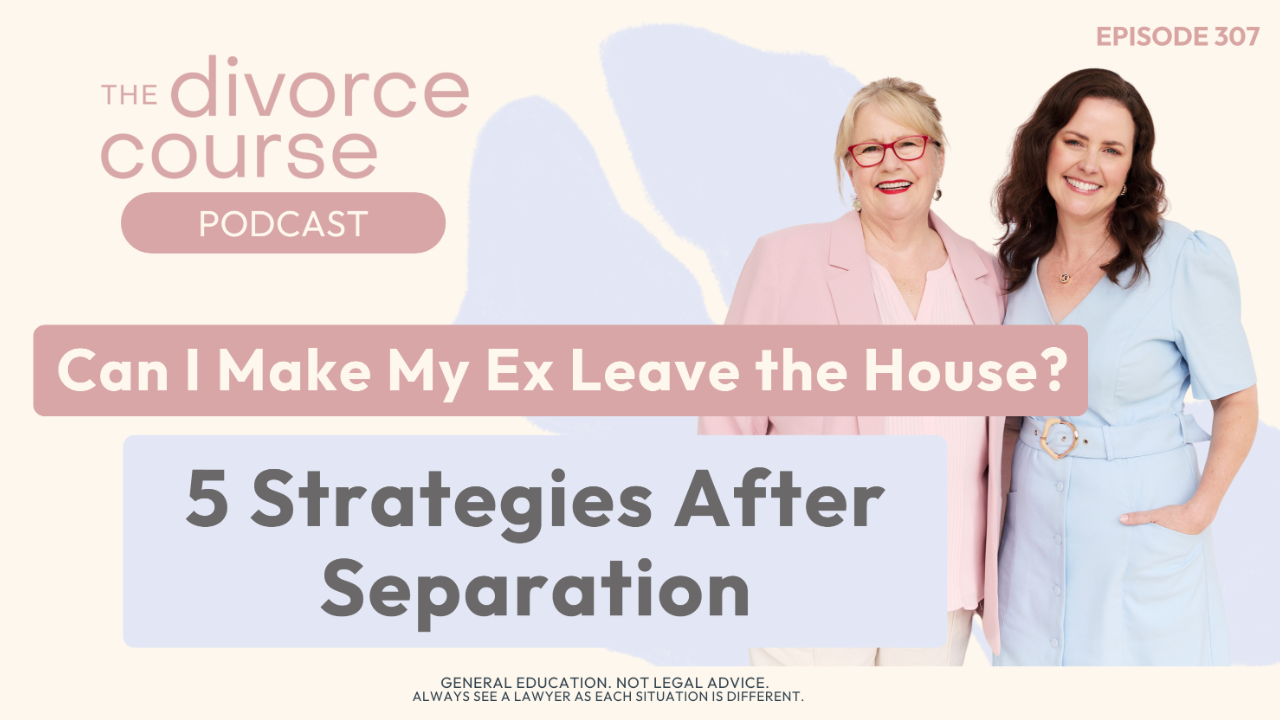
In this episode of the podcast, Mum and I unpack five realistic ways people create space after separation — without damaging their property settlement or making the situation worse.
If you’re feeling stuck, this conversation might help you see that you actually do have options.
⚖️ Important: This article provides general educational information about separation and Australian family law. It is not legal advice and should not replace advice from a qualified legal professional about your specific circumstances.
The Myth That Keeps People Trapped
One of the biggest myths we hear is this:
“If you leave the house, you lose your rights to it.”
This belief keeps many people stuck in unhealthy living situations for months — sometimes even years.
But in most cases under Australian family law, leaving the home does not mean you lose your rights to the property.
Your entitlement to the house forms part of the property pool, and that is assessed later during property settlement.
That means you do not have to stay in a stressful environment simply because you’re afraid of losing your share.
Of course, every situation is different, and it’s always wise to seek legal advice — but the myth itself is incredibly damaging.
What You Should Never Do During Separation
Before talking about the ways people create space, it’s important to address what not to do.
Some things that might feel emotionally satisfying in the moment can cause serious legal problems later.
For example:
-
Throwing your ex’s belongings onto the lawn
-
Changing the locks
-
Cutting off electricity or utilities
-
Harassing or intimidating them to leave
Actions like these can be interpreted by the court as controlling behaviour or family violence.
Even if emotions are running high, it’s always better to approach separation strategically rather than reactively.
Five Ways People Create Space After Separation
Every relationship dynamic is different, so not every strategy will work for every couple. But these are the five most common approaches people use to stop living under one roof.
1. Simply Asking Them to Leave
It may sound obvious, but sometimes the simplest approach works.
If both parties are reasonable and focused on the children’s wellbeing, one partner may agree to move out temporarily while the separation process begins.
In these situations, it can help to confirm the agreement in writing so everyone understands what has been decided.
2. A Structured Temporary Arrangement
Another option is to create a temporary living arrangement.
For example:
-
One partner moves out for three to six months
-
Mortgage and bills are discussed upfront
-
The arrangement is clearly temporary while property settlement is negotiated
This approach can provide breathing space without making anyone feel like they are permanently giving up their rights.
3. Nesting or House Swapping
Some separated couples try something called “nesting.”
This is where the children remain in the family home while the parents rotate in and out of the house.
While it can reduce disruption for children initially, nesting can also become emotionally draining because both adults are still sharing the same living environment.
For many families, it ends up being a short-term bridge rather than a long-term solution.
4. The Trial Move-Out
A trial separation can sometimes make the transition easier.
One partner moves out temporarily while the couple attends counselling or takes time apart to see whether the relationship can be repaired.
In reality, these “trial” separations often become permanent — but they can reduce confrontation and help people ease into the next stage.
5. Sole Occupancy or Court Orders
In some situations, it becomes necessary to involve the court.
A sole occupancy order allows one party to remain in the home while the other must leave.
These orders are usually considered when:
-
There is significant conflict
-
The parties cannot agree on who should move out
-
There are safety concerns
However, these orders are serious legal steps and should always be discussed with a lawyer first.
Why Physical Space Matters in Divorce
One of the biggest reasons people struggle with property negotiations is because they are still living in the same environment.
When you share a house during separation:
-
Emotions stay heightened
-
Conflict is constant
-
Negotiations become harder
-
Children may feel the tension
Creating physical space can dramatically improve people’s ability to think clearly, negotiate fairly, and start building their next chapter.
If You’re Feeling Stuck
Separation is rarely something people plan for.
Most people don’t rehearse divorce the way they plan weddings or careers. It can feel overwhelming, emotional, and confusing.
But if you’re currently living under one roof and wondering how you’re supposed to move forward, remember:
You are not the only one facing this situation.
And more importantly — there are options available.
⚖️ Legal & Safety Disclaimer
This article and podcast episode provide general educational information only and are based primarily on Australian family law. They do not constitute legal advice and should not be relied upon as a substitute for advice from a qualified legal professional. Laws and circumstances vary, and you should seek independent legal advice specific to your situation before making decisions about separation, living arrangements, or property settlement.
This article also discusses topics related to family violence and coercive control, which may be distressing for some readers.
If you are in Australia and need support, you can contact:
-
1800 RESPECT – 1800 737 732
-
Lifeline – 13 11 14
-
If you are in immediate danger, call 000
Your safety and wellbeing are the most important priorities.
Listen to the Full Episode
In this episode, we go deeper into:
-
The legal myths around leaving the family home
-
The five strategies couples actually use
-
When courts may step in
-
Safety considerations during separation
🎧 Listen to the full episode to understand your options and decide what might work best in your situation.
Come along to our next free webinar
Stay connected with news and updates!
Join our mailing list to receive the latest news and updates from our team.
Don't worry, your information will not be shared.
We hate SPAM. We will never sell your information, for any reason.