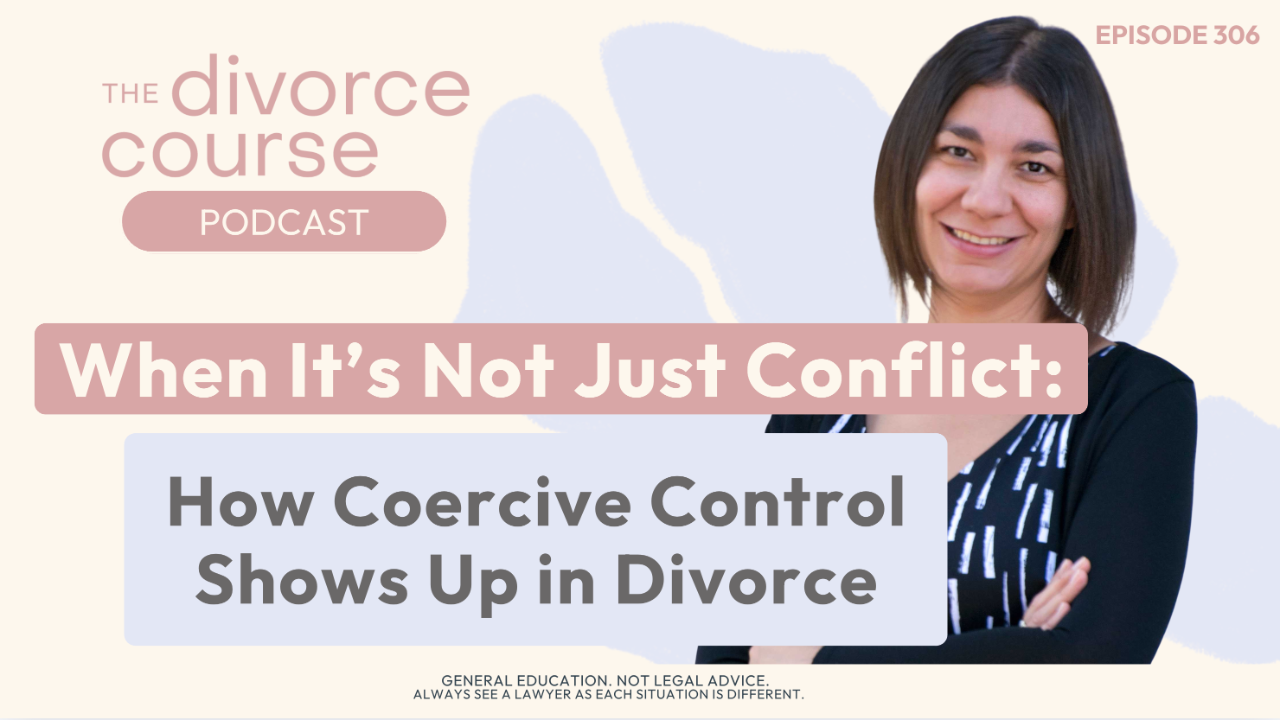
When It’s Not Just Conflict: How Coercive Control Shows Up in Divorce
Have you ever asked yourself:
Is this normal conflict… or is something more controlling happening here?
Maybe there are no bruises.
Maybe there’s never been a single “big” incident.
But you feel confused. Off balance. Guilty. Afraid. Like you’re constantly walking on eggshells.
If that sounds familiar, you need to understand the term coercive control.
In this week’s podcast episode, I sit down with clinical psychologist Kazi Kiva to unpack what coercive control really is, why Australia has criminalised it, how it differs from traditional understandings of domestic violence, and how it continues after separation — especially through legal processes.
If you’ve ever doubted yourself or wondered whether what you experienced “counts,” this episode is for you.
What Is Coercive Control?
Coercive control is not about one argument.
It’s not about one incident.
And it’s not necessarily about physical violence.
It’s a pattern of behaviour designed to create power imbalance, dependency, and domination in a relationship.
For decades, domestic violence frameworks focused on visible injuries and isolated events. But research — and the UK and Scottish legal models that Australia has followed — shifted the focus away from “incidents” and toward patterns of harm over time.
Because the ultimate function of coercive control isn’t violence for violence’s sake.
It’s control.
And that control often hides behind things that look harmless — or even caring — to outsiders.
Why We Had to Move Beyond the “Bruises” Model
One of the biggest shifts in understanding domestic violence has been this:
We are no longer asking, “Was there a visible injury?”
We are asking, “What is the pattern of behaviour, and what harm is it creating?”
You can be:
-
Monitored
-
Micromanaged
-
Financially restricted
-
Subjected to silent treatments
-
Criticised and belittled
-
Forced to justify every decision
-
Isolated from support
And never once have a bruise.
But the harm accumulates.
And over time, you lose autonomy. Confidence. Your sense of self.
The Three D’s of Coercive Control
In the episode, Kazi shares a framework she calls The Three D’s — a powerful way to understand coercive control as a function, not just a list of behaviours.
1. Disrespect
Patronising communication. Double standards. Silent treatment. Unequal rules.
What’s okay for them is not okay for you.
2. Disempowerment
Threats. Intimidation. Micromanagement. Financial control. Setting the pace of everything on their terms.
You feel like you’re losing autonomy and independence.
3. Distortion
Gaslighting. Blame-shifting. Rewriting history. Framing hostility as “care.”
This is the most confusing one — because it makes you doubt your own reality.
And this is often why people don’t realise they’re experiencing coercive control until long after they’ve left.
Why It’s So Hard to Leave
People often ask, “Why didn’t you just leave?”
But coercive control is designed to make leaving feel impossible.
-
Financial dependency
-
Fear of consequences
-
Threats (legal or otherwise)
-
Trauma bonding
-
Identity erosion
-
Isolation from support
There are also high-risk escalation periods:
-
Moving in together
-
Pregnancy or birth
-
Separation
In fact, separation is often the most dangerous time — because the need for control doesn’t disappear. It changes form.
When Control Continues After Separation
One of the most powerful parts of this episode is where we unpack the difference between:
Negotiation vs Coercive Control Tactics
Negotiation mindset:
“Let’s resolve this and move on.”
Coercive control mindset:
“It’s my way or the highway.”
“You’re not moving on unless I allow it.”
The Three D’s show up again in divorce:
Disrespect in Legal Tactics
-
Patronising lawyer letters
-
Silent treatment
-
Double standards
Disempowerment in Court
-
Legal threats
-
Controlling the pace of proceedings
-
Bombarding you with excessive communication
-
Micromanaging areas of your life they no longer have a say in
Distortion in Negotiations
-
Claiming unreasonable demands are “reasonable”
-
Blame-shifting when you don’t agree
-
Framing hostility as “just concern for the kids”
-
Forcing reactions and then using them against you
The key question we discuss:
Is this behaviour about resolving the dispute — or about managing your life?
That distinction changes everything.
How Coercive Control Impacts Children
Children are not just “witnesses.”
They are impacted too.
Even if they’re not directly targeted, they grow up in:
-
An atmosphere of hypervigilance
-
Walking on eggshells
-
Emotional unpredictability
-
Authoritarian control
-
Fear-based environments
Research shows one powerful protective factor though:
One safe, secure, emotionally attuned parent can significantly buffer harm.
If that’s you — you are making more of a difference than you realise.
If You’re Quietly Questioning Everything…
Maybe you’re reading this secretly.
Maybe you’re listening to the podcast in the bathroom at night.
Maybe you’re wondering if this is all in your head.
Autonomy and respect should be present in every healthy relationship. They are not something you have to earn.
If they’re missing, it doesn’t mean you are failing.
It means something is wrong in the dynamic.
And there are people who understand.
🎧 Listen to This Episode If:
-
You’re unsure whether what you experienced was abuse
-
You’ve heard the term “coercive control” but don’t fully understand it
-
You feel confused, guilty or constantly off balance
-
Negotiations during separation feel manipulative
-
You’re worried about how coercive control affects children
-
You want clarity and validation
Resources & Support
If you are in Australia and need support:
-
1800 RESPECT – 1800 737 732
-
Lifeline – 13 11 14
This discussion is general education only and not psychological or legal advice.
You can also explore:
-
Mediation vs Manipulation
-
Legal Abuse
-
Alienation Allegations
-
Safety Planning
All linked in the episode description.
There Is Life On The Other Side
Coercive control creates confusion.
But clarity is possible.
It may take time.
It may take support.
It may take education.
But once you see the pattern, you can’t unsee it.
And from there, you can start protecting your autonomy again.
🎧 Go and listen to the full episode:
When It’s Not Just Conflict: How Coercive Control Shows Up in Divorce
It may just be the piece that makes everything click.
🎧 Listen to this episode if:
You’re unsure whether what you experienced was abuse
You’ve heard the term “coercive control” but don’t fully understand it
You feel confused, guilty or constantly off balance in your relationship
Negotiations during separation feel manipulative rather than constructive
You’re worried about how coercive control affects children
You want clarity and validation around your experience
This episode discusses family violence and may be triggering for some listeners. If you need support, please reach out to 1800 RESPECT (1800 737 732) or Lifeline (13 11 14). This discussion is general education only and not psychological or legal advice.
⏱️ Episode Timeline: When It’s Not Just Conflict: How Coercive Control Shows Up in Divorce
[00:00] – Is This Normal Conflict or Something More?
[01:45] – Safety Disclaimer & Family Violence Support Services
[02:35] – Why Naming Coercive Control Matters
[03:35] – What Coercive Control Actually Is (Simple Definition)
[04:32] – Patterns, Not Incidents: Why Abuse Isn’t Always Obvious
Why domestic violence is no longer viewed as isolated incidents but as ongoing patterns of behaviour that create harm over time.
[05:35] – No Bruises, Still Harm: Emotional & Psychological Abuse Explained
How gaslighting, micromanagement, silent treatment and financial control cause real psychological damage without visible injuries.
[07:13] – How Do You Explain Coercive Control to Others?
[10:03] – The Three D’s: Disrespect, Disempowerment & Distortion
A practical framework to identify coercive control behaviours in relationships and divorce negotiations.
[11:09] – Disempowerment: Fear, Micromanagement & Loss of Autonomy
How controlling partners create dependency, intimidation and fear of consequences — even without physical violence.
[12:11] – Post-Separation Control: When Abuse Continues After Divorce
Why coercive control often escalates during separation, mediation and family court proceedings.
[13:59] – Disrespect & Double Standards in Abusive Relationships
[16:27] – Distortion & Gaslighting: Rewriting Reality
[18:48] – Narcissism vs Coercive Control: What’s the Difference?
Understanding the overlap between narcissistic traits and coercive control in emotionally abusive relationships.
[20:09] – Seeing the Whole Pattern (Not Just One Argument)
Why focusing on single incidents hides the broader pattern of domination and manipulation.
[21:56] – How Coercive Control Impacts Children
Why children are not just witnesses but victims in coercively controlled households — including hypervigilance and emotional harm.
[24:22] – Protecting Children in Family Court
How concerns about coercive control can be reframed as “alienation” — and why understanding legal narratives matters.
[25:34] – One Safe Parent: The Protective Buffer for Kids
[26:15] – Why It’s So Hard to Leave an Abusive Relationship
Financial dependence, fear, threats, trauma bonding and loss of autonomy explained.
[27:56] – The Power Myth: Why Abusers Seem So Smart and Untouchable
[28:54] – Trauma Bonding Explained
The cycle of highs and lows that keeps people emotionally attached in abusive dynamics.
[30:01] – Court Fears & Post-Separation Abuse
Why people fear family court when coercive control continues through legal processes.
[31:03] – Negotiation vs Control: The Simple Test
How to tell the difference between genuine divorce negotiation and manipulation disguised as cooperation.
[33:05] – The Three D’s in Legal Tactics
[34:15] – Legal Examples: Silent Treatment, Rigid Demands & Pressure Tactics
Recognising micromanagement, unreasonable timelines, and threats dressed up as “legal process.”
[38:04] – Using Children to Maintain Control After Separation
Excessive updates, micromanaging parenting decisions, and control disguised as “concern.”
[44:25] – Hold Onto Clarity: Documenting Patterns of Abuse
Why writing things down helps counter gaslighting and protects your psychological stability during divorce.
[46:37] – Legal Narratives & Gatekeeping in Court
How coercive control can be minimised or reframed in legal settings — and why showing patterns matters.
[48:12] – Hope, Support & Life After Coercive Control
side.
[49:06] – Workshop Resources & Next Steps
🔗 Resources Mentioned
1800 RESPECT – 1800 737 732
Lifeline – 13 11 14
https://kirovapsychology.com.au/ (Melbourne workshops & resources)
Previous episodes on:
Mediation vs Manipulation https://youtu.be/cmcFWXD2EBs?si=LOOTB_BwYJIQSmn9
Legal Abuse: https://youtu.be/h2Pu2MmbDxw?si=-HiUdJAfdvoMK8fL
Alienation Allegations: https://youtu.be/g8ofj-Sp3n4?si=_0tX3XSweEMzYp6o
Safety Planning https://youtu.be/R4M8Hr9cbh0?si=0XyklWL2VMwx_cmN
Come along to our next free webinar
Stay connected with news and updates!
Join our mailing list to receive the latest news and updates from our team.
Don't worry, your information will not be shared.
We hate SPAM. We will never sell your information, for any reason.