
The Real Cost of Divorce in Australia What you'll actually pay in 2026 – and where to save thousands
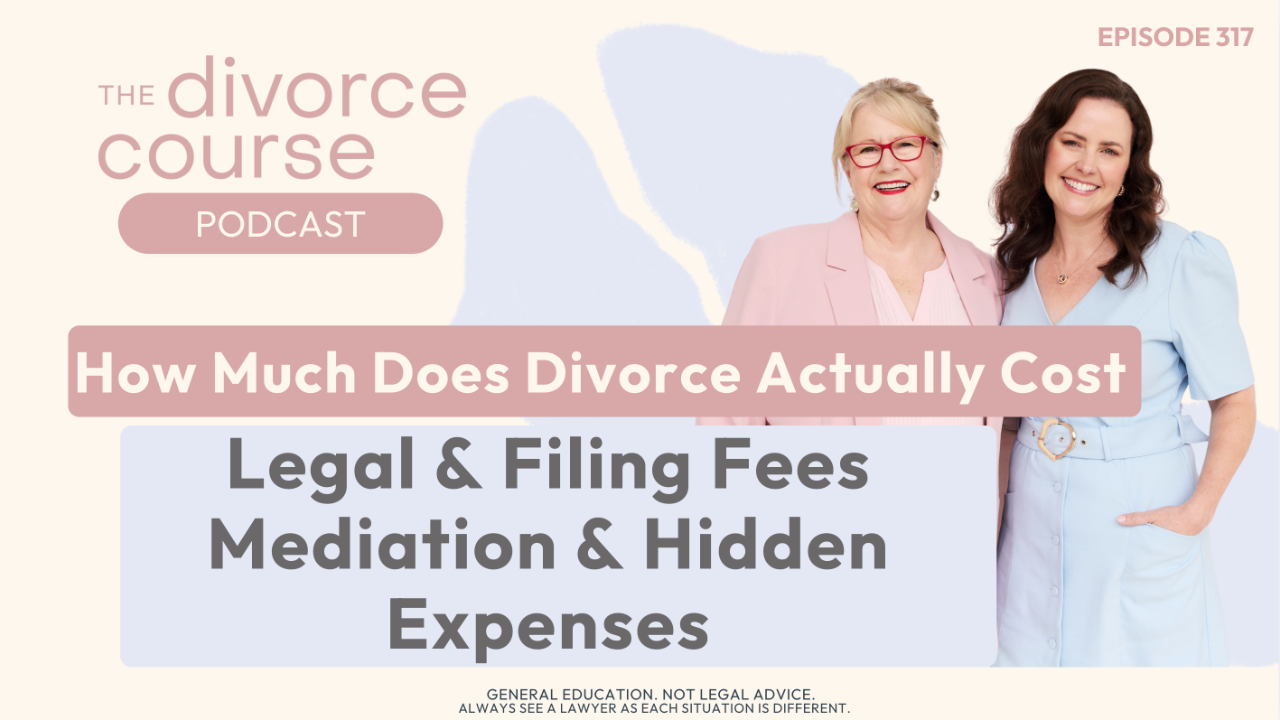
If you've ever sat at the kitchen table at 2am Googling "how much does divorce cost in Australia," you are not alone. It's one of the three biggest fears people have about leaving – right up there with losing their kids and walking away with nothing.
And the horror stories don't help. One person tells you they spent $750,000 on legal fees. Another says they burned through $20,000 before anything even happened. Your ex might be telling you to "leave the lawyers out of it" because it'll just get too expensive. And somewhere in the back of your head, you're starting to wonder if you can actually afford to do this at all.
So let's pull back the curtain. Here's where the money actually goes in an Australian divorce in 2026 – and, more importantly, where you can save thousands by being smart about it.
Why the cost of divorce varies so wildly
The first thing to understand is this: the cost of divorce isn't a single number. It's a moving target shaped by your situation, your ex's personality, and the choices you make along the way.
Some people genuinely do get through for a few thousand dollars. Others spend hundreds of thousands. The difference usually isn't luck. It's strategy.
Here's what you're actually paying for when you go through a separation:
- The divorce application itself (the paperwork that ends the marriage legally)
- Property settlement – dividing assets, debts, super, and the house
- Children's matters – parenting arrangements, school decisions, holidays
- Negotiation costs – letters, phone calls, emails, meetings with your lawyer
- Disclosure – the financial documents both sides have to share
- Mediation – the mediator's fee, plus your lawyer if you take one
- Court – filing fees, hearings, barristers if it goes that far
And here's the kicker: the actual divorce – the bit that legally ends the marriage – is usually the cheapest part of the whole process. The big costs come from everything around it.
The cheapest part: the divorce application
In May 2026, filing a divorce application yourself costs $1,125. If you qualify for a fee concession, it drops to $375. You can do it online. You don't need your ex to agree. You don't need a lawyer for this part at all.
Despite what some people think, there's no American-movie scenario where your ex refuses to "sign the papers" and you're stuck married forever. If you've been separated for 12 months and one of you wants out, the court will grant the divorce.
If anyone ever tells you, "They won't give me a divorce" – take your divorce. You do the paperwork. They can throw a tantrum all they like.
Where the money really goes: negotiation and disclosure
This is the part nobody warns you about.
Most lawyers in Australia are charging somewhere between $400 and $1,000+ per hour in 2026. A common rate is around $660 an hour. And lawyers bill in six-minute increments, which means even a short phone call costs you $66. A longer letter that needs a couple of redrafts? That can run to $1,500–$2,000. A 20-page email you fire off at midnight because your ex did something infuriating? Your lawyer has to read it, draft a response, then re-read your reply. You're paying for all three.
Then there's disclosure – sharing every bank account, super statement, payslip, and tax return with the other side. If you hand your lawyer a neat, organised bundle, they can read it in 30 minutes for around $330. If you drip-feed documents over weeks, or dump a chaotic pile on their desk, you can easily run up thousands in reading fees alone.
Disclosure is the single biggest budget blowout we see. It's also the area where you have the most control.
Mediation: $10,000 or more for a single day
Private mediation is often pitched as "the cheaper alternative to court." And sometimes it is. But the numbers can still be eye-watering.
A mid-range mediator costs around $5,000 for a full day, split between you and your ex. Take your lawyer with you and you're looking at another $5,600+ in their hourly fees for the day. Add a barrister – which is increasingly common – and you can tack on $7,000 to $10,000 on top of that.
That's potentially $20,000 in one day. With no guarantee of an outcome.
None of this means mediation is a bad idea. Done well, it can save you the cost and trauma of court. Done badly – walking in unprepared, with unrealistic expectations, against a high-conflict ex – it's an expensive way to get nowhere.
The hidden costs nobody warns you about
Beyond the big-ticket items, there are dozens of small charges that quietly add up:
- Photocopying and scanning (yes, lawyers still charge for this – sometimes per page)
- File notes after every phone call
- Reading every email you send – and every email your ex's lawyer sends to yours
- Drafting consent orders (around $2,640–$4,000 just for that step)
- Filing fees for consent orders ($205 in the court)
- Late-night anxiety emails that need a 30-minute response
Sending documents to your lawyer in dribs and drabs instead of one organised bundle. Using your lawyer as a sounding board for your feelings instead of seeing an actual therapist. Letting your ex set the pace by demanding endless responses. All of these quietly drain your property pool.
How to spend less on your divorce
Here's the part we wish someone had told us at the beginning.
You don't have to do this with a lawyer attached to your hip from day one. You can do a lot of this yourself – safely, strategically, and without giving up your rights.
- File the divorce application yourself. It's straightforward and saves you the lawyer's hourly rate on top of the court fee.
- Do your own disclosure preparation. Build a Google Drive folder, index it, gather your documents – then hand the whole thing to your lawyer in one go. You'll save thousands.
- Get educated before you walk into a lawyer's office. The more prepared you are, the less you pay for them to bring you up to speed.
- Use your lawyer for the hard bits – the strategy, the legal advice, the bits you genuinely can't do yourself. Don't pay them to write letters about furniture or send no-brainer responses.
- Don't go to mediation just to "see what happens." Walk in with a clear understanding of the law, your numbers, and what you're prepared to accept.
- Find a therapist. Lawyers are not trained to manage your anxiety, grief, or rage – and at $660 an hour, they are the most expensive place to process your feelings.
Who pays for the legal fees in the end?
By default in Australia, each party pays their own legal fees. That's Section 114UB of the Family Law Act. In rare cases – usually when one party has behaved badly or rejected reasonable offers – the court can order one side to pay the other's costs. But you shouldn't count on it.
In practice, your legal fees come straight off your share of the property pool. If the pool is $100 and you split it 50/50, but you've spent $25 on lawyers and your ex has spent $10, you walk away with $25 and they walk away with $40. That's the maths nobody explains at the start.
The bottom line
The cost of divorce in Australia is not fixed. It's not predetermined. And it's not – despite what your ex or your fears might be telling you – something you can't afford to do.
What it is, is something that rewards preparation. The people who spend the least on divorce aren't the ones who avoid lawyers entirely. They're the ones who use lawyers strategically – for the parts where legal expertise actually matters, and not for the parts they can do themselves with a bit of guidance.
🎧 Listen to the full episode
For the full breakdown – including exactly what a letter costs, why your ex's drip-feeding is costing you money, and the strategies Mum and I wish we'd known when we started – have a listen to the episode this post is based on:
Episode: How Much Does Getting Divorced Actually Cost? – available now on Spotify, Apple Podcasts and YouTube.
🎟️ Want help putting this into practice?
We run a free webinar walking you through the five biggest mistakes people make in divorce – and exactly how to avoid them. We'll show you what to prepare before you see a lawyer, how to keep your disclosure costs down, and how to walk into your first meeting saving yourself thousands.
Register at www.thedivorcecourse.com.au – just click "Reserve My Seat."
This blog post is general information only – not legal advice. The figures quoted reflect Australian family law and court fees as at May 2026 and may have changed since publication. Always consult a qualified family lawyer about your specific situation. If you or someone you know is in danger, call 000. For confidential support, call 1800 RESPECT on 1800 737 732.
All our best,
Laura & Lyn
Your Guides By Your Side
Co-Hosts of THE DIVORCE COURSE PODCAST
Come along to our next free webinar
Stay connected with news and updates!
Join our mailing list to receive the latest news and updates from our team.
Don't worry, your information will not be shared.
We hate SPAM. We will never sell your information, for any reason.