
Building Your Divorce Support Team: Who Belongs in Your Corner (and Who to Bench)
You can do everything right in your divorce the paperwork, the disclosure, the strategy and still find yourself absolutely exhausted and off track. And sometimes it's not because of anything you're doing. It's because of the people standing around you while you're doing it.
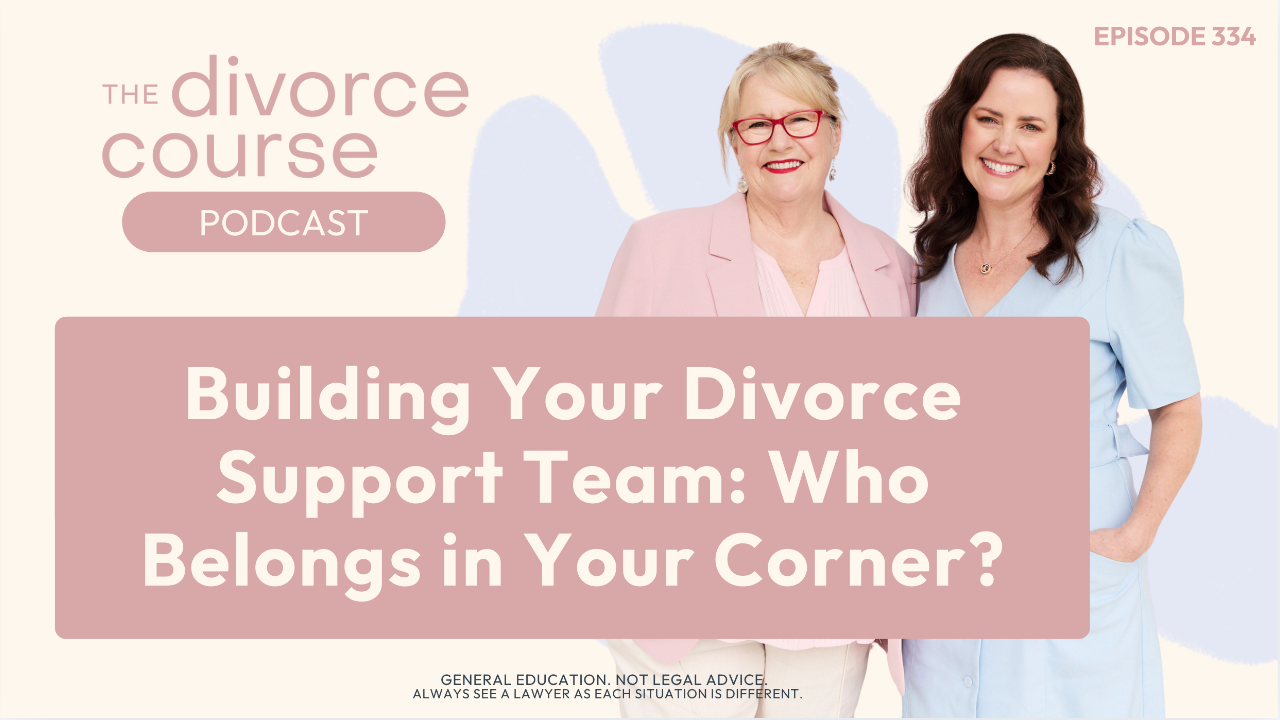
The right people will make this process smoother, faster, cheaper and safer. The wrong people will cost you money, time, evidence, peace and sleep. In Episode 334 of The Divorce Course Podcast, Mum and I walk through your whole support team who belongs in your corner, who doesn't, and how to tell the difference.
What we realised is you don't usually choose your support team. You're too busy putting out fires. People just pop into your life, text messages, phone calls, someone at the school pickup, a family member you haven't spoken to in years suddenly messaging you. Before you know it, you're surrounded. The question is whether you're surrounded by the right people.
The One Simple Test
For every person in your life right now; family, friends, lawyers, community groups, your church, all of them, there's one question to ask:
Are they helping me get through this, or are they costing me something?
That's it. And you have full permission to bench the ones who fail, even temporarily, even if they're family. Benching someone isn't cutting them off forever. It's setting a boundary until you're through this.
First Things First: Your Ex Is Not on Your Team
Even if you're amicable. Even if you're besties. Your ex is not a support category. If they're still trying to influence your day-to-day decision-making after separation, it's time for boundaries: keep things in writing, keep it businesslike, and don't let guilt or people-pleasing pull you back into letting them steer.
Family: Love Isn't the Same as Help
Some family belong right beside you. Others need respectful distance while you get through this – and it can be hard to tell them apart, because a lot of the unhelpful stuff comes from love or misunderstanding.
Watch for family members who pressure you to reconcile when it's not safe, who care more about how the divorce "looks" than how you're actually living, or who push you to "keep it amicable". That phrase deserves a closer look, because a manipulative ex will often go to your family first and say, "if only they'd just be reasonable, this would all be over" – even when the offer on the table is wildly unfair. In that context, "keep it amicable" is code for "just give in". You don't need that pressure in your corner.
The family you want? The ones offering to mind the kids, cook dinner on court days, or quietly say, "I never liked them. I hated how they treated you." As Mum shares in the episode, sometimes the person who saw behind your ex's mask is worth more than a dozen well-meaning relatives who were taken in by the charm.
And one important note: it is not your job to explain coercive control or family violence to everyone. You only need to justify yourself to the court or your lawyer. Everyone else can take a back seat.
In-Laws: Press Pause, Even on the Good Ones
If you've got a lovely relationship with your in-laws, this one hurts. But they may be the only support your ex has, and it isn't fair on them or on you to keep them in the middle. A gentle "I love you to bits, but let's put our catch-ups on hold until this is over" protects everyone.
On the flip side, some in-laws have enabled your ex their whole life and will come out guns blazing. Distance yourself from those ones quickly. And if you have a family violence or protection order, remember: an ex isn't allowed to use family members to contact you either. We cover this in more detail in our episode on in-laws interfering in your divorce (Episode 305 – linked below).
Friends: "Neutral" Is Not in Your Corner
The friends who belong on your team are the ones rolling up their sleeves ; packing boxes, picking up kids, sitting with you in the court waiting room.
The ones who don't? Anyone who declares "I'm neutral". They don't have to pick a side, and that's fine,but a neutral friend can't be your divorce support. It doesn't end the friendship. It just means they get moved to the outer for now.
Watch out too for the gossip collectors ,the friends who are there for the information but not the help – and the joint friends who might be screenshotting your Facebook posts and sending them to your ex. (Yes, that happens. It happened to me.) Which brings us to a golden rule: don't live this chapter of your life on social media. Anything you post can end up attached to an affidavit.
And please, keep some fun friends close. Not everyone on your team needs to be serious. A cup of tea and a laugh over a silly meme can give you back just enough energy to get through the next hard thing. You're allowed glimmers of joy.
Your Lawyer: Brave, Honest and In Your Corner
The right lawyer balances support with objectivity. You want someone who can tell you "no, that won't work" early – not someone so afraid of losing you as a client that you find out in court what they should have told you at the first meeting.
Red flags to watch for: a lawyer who gate-keeps your story and decides the court "doesn't need to hear" about family violence or coercive control (we did a whole episode on this – Episode 166, linked below), or one who pressures you to accept a low settlement just to move your file along.
Mum's old rule of the three As applies: affability, availability, ability. Clients tend to rank friendliness first, but at the end of the day, ask yourself whether that lovely bedside manner is going to translate into confident representation and a good outcome.
The Rest of the Team: Psychologist, School, Community
A psychologist of your own... not the joint marriage counsellor, gives you somewhere to put the emotional load, because letting emotion drive your legal strategy is one of the most expensive mistakes you can make in divorce.
If you have kids, find one trusted contact person at their school plus the school counsellor. One conversation, disseminated to the right people, instead of a dozen stressful chats at drop-off.
And if you're part of a faith community, use it for what it's for spiritual sustenance, not for property settlement opinions. If people there are pressuring or shaming you, you're allowed to set boundaries even in the places where you draw your greatest strength.
Finally, audit your information sources. Podcasts, Reddit threads and Facebook groups that confidently give the wrong information can cost you a longer, more expensive, more stressful divorce. Make sure the voices in your corner actually know Australian family law.
Match Your Team to Your Ex
One size doesn't fit all. If your ex is high-conflict, you need calm, steady supporters who won't rev you up – facts are king, and you don't want an army escalating things. If your ex is avoidant, you'll likely be doing the heavy lifting yourself, so recruit friends willing to do the hard yakka and keep your spirits up. If your ex is manipulative and controlling, vet your team carefully – watch for "flying monkeys" who've been recruited to their side, and treat joint friends as high-risk. And if you're amicable? You still need a team, both to get things locked in quickly while it stays amicable, and to have truth-tellers who'll ask, "is it only amicable because you never say no?"
It's Your Decision
If Mum could embroider one thing on a cushion for you, it would be this: it's my decision. All those people around you are called supports for a reason – they can hold you up, but they can't decide for you. Whether you settle, whether you go to court, how you run your divorce – that's yours.
So have a think about who's on your team right now. A little pruning, a little respectful distance, and suddenly you've got the head space you need to get through this.
🎧 Listen to the full episode: Building Your Divorce Support Team: Who Belongs in Your Corner? (Episode 334)
Episodes mentioned:
- 10 Essential Boundaries for a Healthier Divorce (Episode 173)
- When In-Laws Interfere in Your Divorce (Episode 305)
- Legal Gatekeeping: Is Your Lawyer Telling Your Full Story? (Episode 166)
This blog post is general information only – it is not legal advice. Australian family law may not apply to your specific situation or jurisdiction, and laws may have changed since publication. Always consult a qualified family lawyer about your individual circumstances.
If anything in this post has raised concerns for you, or you realise you may be experiencing family violence or coercive control, please call 1800 RESPECT (1800 737 732). If you're feeling distressed, Lifeline is available on 13 11 14. In an emergency, always call 000.
All our best, Laura & Lyn Your Guides By Your Side Co-Hosts of THE DIVORCE COURSE PODCAST
Come along to our next free webinar
Stay connected with news and updates!
Join our mailing list to receive the latest news and updates from our team.
Don't worry, your information will not be shared.
We hate SPAM. We will never sell your information, for any reason.