
DIY Divorce in Australia: What You Can Do Yourself (Without Winging It)
General information only – this article is not legal advice. Australian family law may not apply to your situation or jurisdiction, and laws may have changed since publication. Always consult a qualified family lawyer about your individual circumstances.
Family lawyers commonly charge somewhere between $500 - $1000 an hour. For many separating couples, that number alone decides how the next year of their lives will look and whether there will be anything left for a house deposit at the end of it.
Here's what most people are never told: you can do far more of your own divorce, property settlement and parenting arrangements than you might think. The family law system was actually designed with that in mind. But there's a catch. A DIY divorce doesn't mean doing it alone, and it definitely doesn't mean winging it.
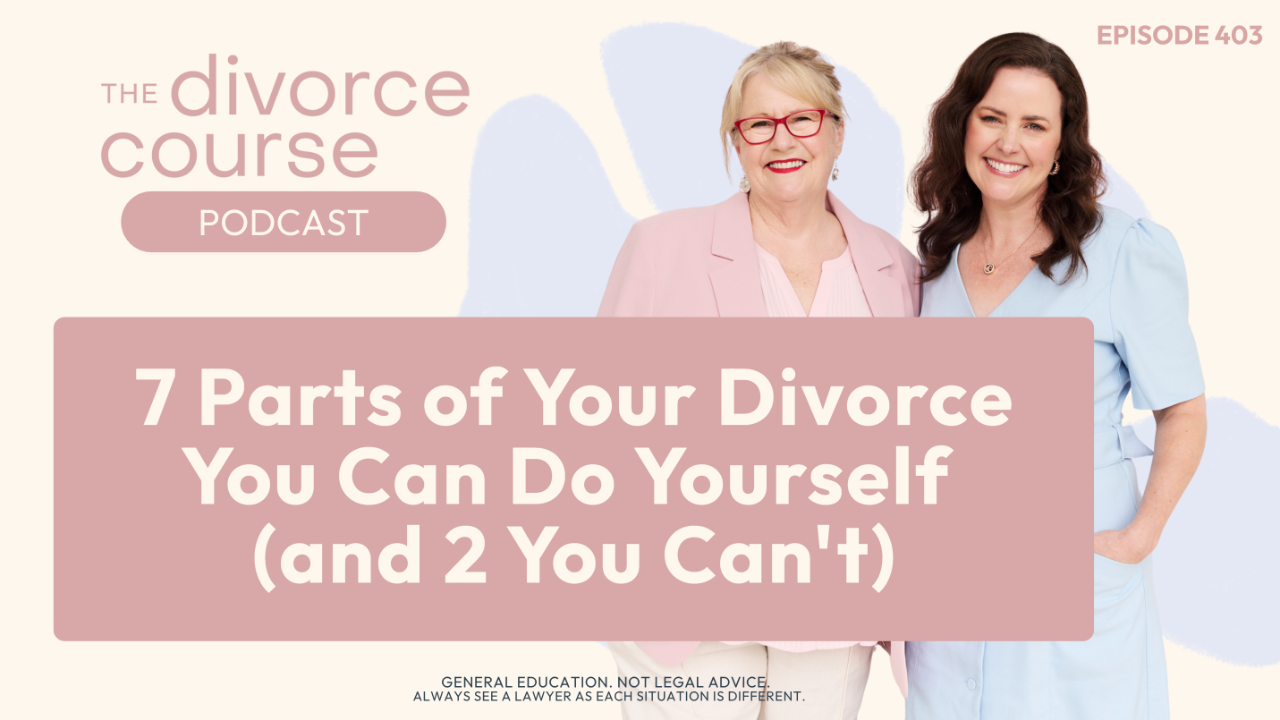
On a recent episode of The Divorce Course Podcast, Laura and Lyn – a family lawyer with 35 years' experience – walked through which parts of a separation you can realistically handle yourself, which parts need a lawyer's eye, and the difference between a DIY divorce and a "wing it" divorce that comes back to bite you.
Why do people choose a DIY divorce?
Money is the big one. Many people sign up with a lawyer expecting to afford the whole journey, then find their funds are gone before they reach mediation – let alone court. With a small property pool, paying for full legal representation at every step often just doesn't add up.
But cost isn't the only reason. Some people have a Legal Aid lawyer who is brilliant but stretched across a heavy caseload, and they want to understand the next step so they can keep things moving. Others simply want control over the pace – knowing the deadlines, having documents ready, and not finding out about a filing date at the last minute. And as Lyn points out, the system itself expects most separating couples to reach their own agreements: consent orders and mediation exist for exactly that reason.
What are the steps to settle property after separation?
- List your property pool.
- Do your disclosure.
- Work out contributions and future needs.
- Negotiate.
- Formalise it. Turn the agreement into consent orders (or, with lawyers for both of you, a binding financial agreement).
Do I really need to formalise an amicable agreement?
Usually yes – and this is where "winging it" causes the most damage. A kitchen-table agreement isn't legally binding. Until there's a sealed court order or a valid financial agreement, your ex may be able to come back years later and ask for a property settlement, often when your circumstances (and the value of what you kept) have changed. There's a practical bonus too: transfers of the family home made under family court orders may be exempt from stamp duty (section 90 of the Family Law Act), which can be a significant saving.
What parts of a divorce can you do yourself?
- Your divorce application – if you've filled in a Centrelink form, you can manage this.
- Your disclosure – sorting, scanning and organising your own documents (and reviewing your ex's).
- Your asset and debt list – start it yourself and refine it as disclosure comes in.
- Valuations – organising single-expert valuations, as long as the correct letters are used.
- Writing your proposal – to your ex, or to their lawyer if they have one.
- Mediation – booking it, preparing for it and attending it, which you can do without a lawyer.
- A parenting plan – drafting it in detail yourself.
- Consent orders – completing the application and filing it yourself on the court portal.
Doing this groundwork yourself can save a surprising amount. Handing a lawyer bags of unsorted paperwork means paying professional rates for someone to discard old warranties and school uniform receipts.
When should you see a lawyer in a DIY divorce?
The episode recommends two checkpoints that are worth paying for, even on a tight budget:
- Before you negotiate – get independent advice on your likely percentage entitlement, so you know what a fair outcome looks like. This can be a one-off, "no strings attached" appointment, not a lifelong retainer.
- Before you sign consent orders – have a lawyer check that the orders actually say what you think they say, and test the "what ifs".
It's also worth getting advice on genuinely tricky issues, such as trusts or a large contribution one person brought into the relationship. Many situations people assume are unusual – a business, a new partner – are things courts deal with every day.
Some things can't be DIY'd at all. A binding financial agreement requires each person to have their own lawyer. And while people can and do represent themselves at trial, it's genuinely difficult – which is the strongest argument for saving your legal budget for the stages where a lawyer can change the outcome, rather than spending it on mediation and paperwork you could have handled yourself.
What's the difference between DIY and winging it?
A DIY divorce is like a well-planned renovation: you learn the steps, follow the plans, and get the professional to check the critical bits. Winging it is knocking down walls without measuring. The difference usually shows up in four places:
- Skipping formal orders because you're "amicable".
- Skipping disclosure because you trust each other – think of disclosure as due diligence before signing anything.
- Vague parenting plans – "50/50" doesn't cover Christmas, birthdays, Mother's and Father's Day, school holidays, sickness, passports or relocation. Detail now prevents arguments later.
- No system – a dedicated email address and organised digital folders for correspondence and disclosure save time, stress and lawyer fees when you need to send something quickly.
The main risk of DIY is that you don't know what you don't know. When you're emotionally invested, it's easy to fixate on an issue that matters deeply to you but won't move a court. That's exactly why the checkpoints matter.
The bottom line
You don't need to hand over your whole divorce – or your whole bank balance – to get a fair outcome. Learn the steps, do the groundwork yourself, see a lawyer at the moments that count, and formalise what you agree. As Lyn puts it: it's not rocket science.
Listen to the full episode
Hear the whole conversation on The Divorce Course Podcast – search "The Divorce Course Podcast" on Apple Podcasts, Spotify or YouTube.
Related episodes:
- 4 Ways to Agree in Divorce or De Facto Separation but Only One Is Legally Binding
- Do I Really Need a Lawyer for My Divorce or De Facto Separation?
- Disclosure: The What, Why, When & How
- Worried About Your Divorce Lawyer? Delays, Bills and Backpedaling
If you are experiencing family violence or coercive control, some steps may need extra safety planning. Support is available: 1800 RESPECT (1800 737 732), Lifeline (13 11 14), and in an emergency, 000.
This article is general information only and is not legal advice. It reflects Australian family law at the time of writing, which may have changed, and it may not apply to your specific situation or jurisdiction. Always consult a qualified family lawyer about your individual circumstances.
Come along to our next free webinar
Stay connected with news and updates!
Join our mailing list to receive the latest news and updates from our team.
Don't worry, your information will not be shared.
We hate SPAM. We will never sell your information, for any reason.