
Does Cheating Affect Your Divorce Settlement in Australia?
General information only – this article is not legal advice. Australian family law may not apply to your situation or jurisdiction, and laws may have changed since publication. Always consult a qualified family lawyer about your individual circumstances.
You've just found out your ex was cheating. Maybe it ended the marriage. Maybe you discovered it afterwards, going through old bank statements a diamond ring you never received, a hotel you never stayed at. And when you finally raised it with your lawyer, they barely blinked.
That reaction floors almost everyone. The betrayal that is consuming your every waking thought is, legally speaking, close to irrelevant. But "close to" is doing some work in that sentence because there are places where an affair genuinely can matter in Australian family law, and knowing the difference can save you thousands in legal fees and a great deal of heartache.
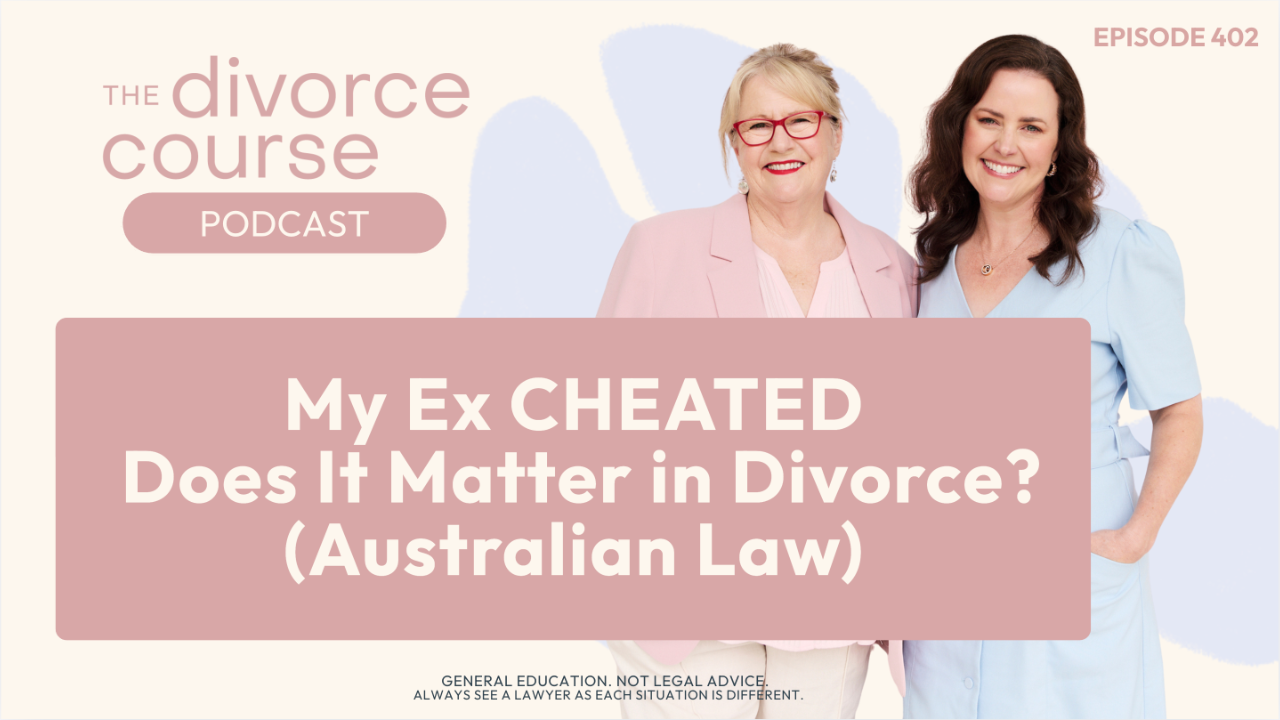
On a recent episode of The Divorce Course Podcast, Laura and Lyn a family lawyer with 35 years' experience unpack exactly where that line sits.
Why doesn't the court care that my ex cheated?
Because Australia has no-fault divorce. It wasn't always so under the old matrimonial causes legislation, you could only divorce on grounds like cruelty, desertion or adultery, which is why private investigators used to leap into bedrooms with cameras. The Family Law Act 1975 swept all of that away. Today the only basis for divorce is that the marriage has broken down irretrievably, demonstrated by 12 months of separation. Who did what to whom doesn't decide the divorce, and phrases like "unfit mother" or "adulterer" carry little weight on their own.
When cheating does matter: follow the money
Here's what courts might be interested in: if joint money or wages earned during the relationship was spent on an affair, that spending can be taken into account when the property pool is divided. Think gifts, jewellery, hotels, holidays, dinners, rent on a second apartment, even an entire second household.
Two important limits. First, what an ex spends on a new partner after separation is generally their own business the court's focus is money spent during the relationship.
Second, judges work within a range of roughly ten per cent when apportioning a settlement, so conduct like this tends to push you toward the higher end of the range rather than rewriting the outcome entirely. It's an adjustment, not a windfall and not a punishment.
How do you prove money was spent on an affair?
Disclosure. This is where many people finally learn the truth, the recurring payment they never knew about, the florist and jeweller charges that don't line up with their own birthday, the trip to Hong Kong they weren't on. If your ex is dragging their feet on disclosure, an affair (or gambling, or similar spending they'd rather you not see) is sometimes exactly why. Add the amounts up, get a number, and hand it to your lawyer, then force yourself to look at the rest of the disclosure with a wider lens, because a person who hid an affair may have hidden other things too.
Can cheating affect parenting arrangements?
Not in the way most people hope. The court doesn't referee the affair, and the decision about when children meet a new partner belongs to the parent who has re-partnered you can ask for a delay, but you generally can't enforce one in court orders (a parenting plan can record an agreement, though it isn't enforceable). Where the court does take real notice is safety: if a new partner has a concerning history, child safety and police records can be subpoenaed, and courts can and do make orders restricting contact in serious cases. A revolving door of new partners can also trouble the court, because the children's best interests are paramount.
And please listen when we say your reaction is sometimes watched more closely than their cheating. Fixate on the affair in a family report interview and you risk being described as someone who hasn't moved forward. React angrily at handovers and you hand your ex the "jealous ex" narrative. It is profoundly unfair because they caused the hurt, and you carry the burden of composure but knowing this in advance is protection for you in family court.
Negotiating a settlement while you're heartbroken
People betrayed by a partner tend to swing like a pendulum: from "I want nothing, I'm done" to "I want what's fair" to "I want to make them pay". None of the extremes serve you. Walking away with nothing punishes your future self; chasing justice through the courts mostly buys legal fees and misery. The aim is the middle: know what a judge would realistically order, and anchor to that number.
A few hard-won tips from the episode: if a guilty ex makes a generous offer, consider grabbing it while the guilt lasts properly documented in consent orders or a binding financial agreement, a generous deal can stick. If you can, give yourself a buffer before mediation; the partner who left has usually been planning for months while you're still in shock, and grief has stages that don't negotiate well. And never negotiate to punish delay and point-scoring get noticed, and they get used against you.
The emotional side is real it's just a separate job
Discovering an affair can shatter your sense of reality, and when blame gets turned back on you "you're the reason I strayed", "you're paranoid" it can shade into gaslighting and emotional abuse. That trauma deserves proper support, ideally with a counsellor, and working through it also protects your legal position. One practical trick from the episode: when affair evidence and settlement strategy are competing for your head-space, deliberately separate them deal with the betrayal in one sitting, then consciously switch hats before you look at the numbers.
The bottom line
The court can't give you justice for the affair. It can give you your fair share including an adjustment where joint money funded the cheating and it can protect your children where there's a genuine safety concern. Grieve the betrayal with people who love you, put your reaction where no family report writer can see it, and put your energy into the settlement you'll live off for the next decade. As the episode's cushion embroidery puts it: who cares? Getting to indifference is the win.
Listen to the full episode
Hear the whole conversation on The Divorce Course Podcast – search "The Divorce Course Podcast" on Apple Podcasts, Spotify or YouTube.
Related episodes:
- Are We De Facto? – podcasts.apple.com/au/podcast/are-we-de-facto-what-it-could-mean-for-property/id1503451022?i=1000743246854
- Property or Parenting First? – podcasts.apple.com/au/podcast/property-or-parenting-first-does-the-order-actually/id1503451022?i=1000782876028
- Coercive Control vs a Bad Relationship (series part 1) – podcasts.apple.com/au/podcast/coercive-control-vs-a-bad-relationship-how-to-tell/id1503451022?i=1000774925805
- Coercive Control & Domestic Violence in Family Court – podcasts.apple.com/au/podcast/coercive-control-domestic-violence-in-family-court/id1503451022?i=1000764231660
If anything in this article raises issues for you, support is available: 1800 RESPECT (1800 737 732), Lifeline (13 11 14), and in an emergency, 000.
This article is general information only and is not legal advice. It reflects Australian family law at the time of writing, which may have changed, and it may not apply to your specific situation or jurisdiction. Always consult a qualified family lawyer about your individual circumstances.
Come along to our next free webinar
Stay connected with news and updates!
Join our mailing list to receive the latest news and updates from our team.
Don't worry, your information will not be shared.
We hate SPAM. We will never sell your information, for any reason.