Healing After Coercive Control: How Do You Get Yourself Back?
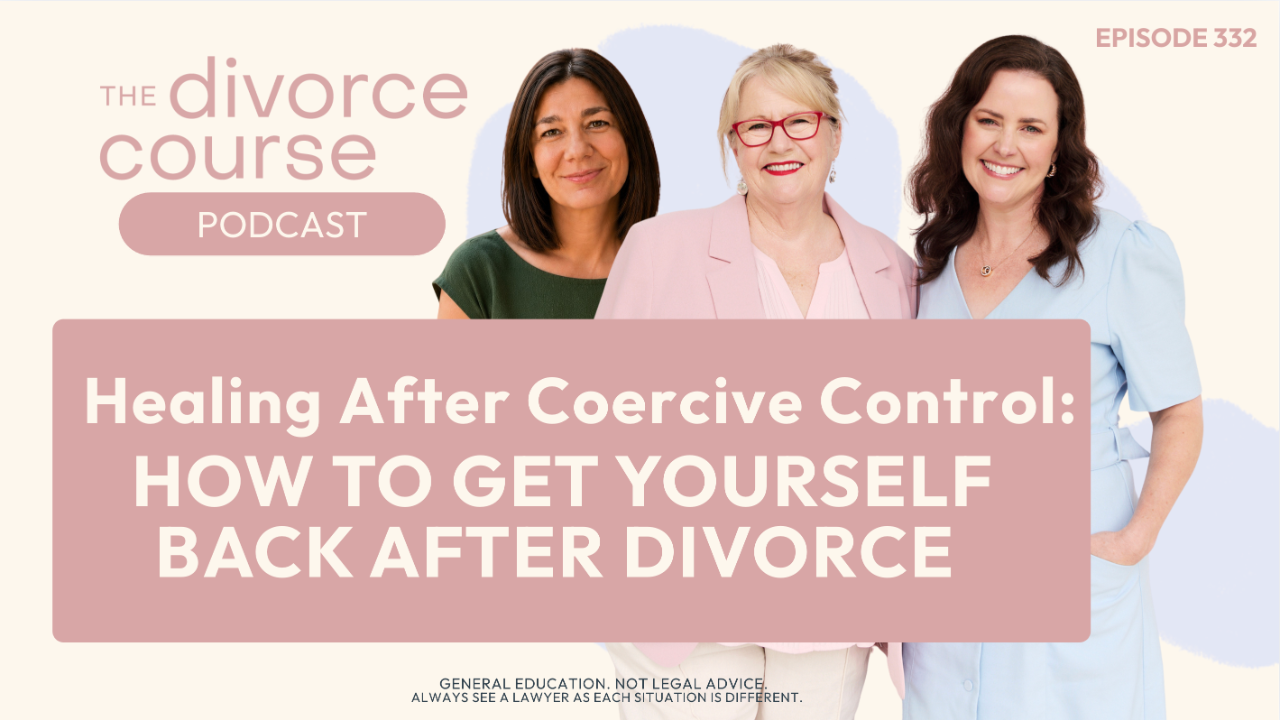
The Divorce Course Podcast, the final part of our six part coercive control series
You left. Or they left. Either way, the thing that was hurting you stopped.
So why doesn't it feel over?
That question came up after every episode in this series, and it's the one the final part is built around. Not the ex. Not the court. Not the evidence. You.
Mum and I sat down with clinical psychologist Krasi Kirova to work through the questions listeners sent in about what happens after the relationship ends and the healing doesn't arrive on schedule.
Here is some of what the episode covers. There is a great deal more in the full conversation, and everything below is general education rather than advice for any individual situation.
Trauma isn't only what was done to you
Krasi explains that trauma isn't just the events themselves. It's what happened inside you because of those events. The way the body learns to brace. The way you start scanning a room, or a text message, for the first sign of trouble.
Framed that way, hypervigilance, exhaustion and constant second-guessing aren't personality flaws to be stuck with. They are symptoms, and symptoms can settle.
She also draws a distinction between one off trauma and what tends to happen with coercive control, which is repeated, prolonged, and inflicted by someone who was supposed to be safe. That last element is part of why it goes so deep. It isn't only fear. It's fear tangled up with love, or with what looked like love at the time.
Why the body is still in the trenches
One listener wrote in to say it had been a year and her body still hadn't got the message.
Krasi covers the window of tolerance, which is the zone where a person can think clearly, feel their feelings and still function. Everyone has one. Living under sustained stress narrows it, sometimes dramatically. Things that were once a minor annoyance can tip someone straight into panic or shutdown, and then comes the frustration at having overreacted.
It isn't an overreaction. The window narrowed because it had to.
It also widens again. Krasi goes through what does that work, and none of it is dramatic. Sleep. Rest. Movement. Small practices repeated consistently rather than big gestures made once. In the moment techniques like grounding and slowing the breath help with getting through a wave. It's the daily and fairly boring repetition that shifts the baseline.
Healing happens faster around other people
Krasi discusses co-regulation, the principle that human nervous systems settle in the presence of other settled nervous systems. It's why a calm friend sitting nearby, saying very little, can do more than an hour of trying to talk yourself down alone.
For anyone who has been isolated, and isolation is one of the things coercive control does most effectively, this is worth sitting with. Rebuilding your people isn't a distraction from the healing. It's a substantial part of it.
Learning to trust your own judgment again
A version of this question came in from several listeners. If I got it this wrong once, how do I know it won't happen again?
Krasi's answer is not the reassuring one. Trust is never certainty. It is always a leap taken with incomplete information, in every relationship. What changes is how the leap is taken. In small increments, watching what someone does over time rather than what they promise in the first month.
The episode also covers why intelligent, capable and kind people end up in these relationships, sometimes more than once. It isn't a lack of judgment. It's often the qualities that make someone a good partner in the first place, including empathy, a willingness to give the benefit of the doubt, and a tendency to explain things away.
Krasi then introduces the shark cage, a model developed by Australian psychologist Ursula Benstead. The ocean can't be emptied of sharks, and nobody controls who they will meet. What can be built is the cage. Knowing your own non-negotiables. Noticing your own alarm bells. Deciding in advance what you will not accept, before you're standing in front of someone charming enough to make you reconsider.
A cult of one
Coercive control has been described as a cult of one.
One person builds a private world with its own rules, and living by those rules becomes the only way to keep the peace. Then the relationship ends, and the rules stay. The checking continues. The anticipating continues. Permission is still being sought from someone who is no longer in the room.
The route out of that, in Krasi's account, isn't dramatic. It's small decisions, made independently, over and over. What to eat. What to watch. What to say yes to and what to decline. Each one puts a little more of your life back under your own authority.
She is also honest that this brings guilt at first, and that learning to feel the guilt without immediately obeying it is part of the work.
How long does recovery take?
Krasi doesn't offer a tidy number, and the episode explains why.
Rebuilding and recovering are not the same thing. Rebuilding is the practical scaffolding, the housing, the money, the routines, and it has a more visible finish line. Recovery is slower and less linear, and it isn't all or nothing. Most people get significant parts of themselves back long before they would describe themselves as healed.
The conversation also covers post-traumatic growth, which is not the same as being grateful for what happened. Nobody is required to be grateful. It describes the way people often come through with clearer boundaries, sharper instincts and considerably less tolerance for nonsense.
The whole series in one place
This was part six, and the last one. For anyone new here, or wanting to work through the series from the beginning, here it is in order.
- Part 1. Coercive Control vs a Bad Relationship: How to Tell the Difference (Episode 323). Naming it, and the difference between a relationship that was unhappy and one that was controlling.
- Part 2. Coercive Control While Separated Under One Roof (Episode 324). Surviving it when leaving isn't possible yet.
- Part 3. Financial Abuse and Coercive Control: When Money Becomes the Weapon (Episode 325).
- Part 4. Coercive Control and Your Kids (Episode 326). Protecting children when the co-parent is the controlling one.
- Part 5. How Do I Prove Coercive Control? The Evidence That Actually Counts (Episode 330).
- Part 6. Healing after coercive control, with Krasi Kirova.
Two others are worth adding for anyone at this stage. Episode 216, The Post-Divorce Glow-Up is an earlier conversation with Krasi on emotional recovery after abuse. Episode 322, Survival Mode in Divorce covers three anchors for steadying yourself when everything feels like too much.
Where to get support
If you are in immediate danger, call 000.
1800 RESPECT is available 24 hours a day on 1800 737 732. Lifeline is on 13 11 14. In Victoria, The Orange Door is a central intake point for family violence support. A GP is also a reasonable first step towards finding a psychologist, and it is worth asking whether they have experience with coercive control specifically, because not everyone does.
Also mentioned in the episode: The Body Keeps the Score by Bessel van der Kolk, the research of Emma Katz on coercive control in the lives of mothers and children, and EMDR as one of the therapy approaches people find helpful.
Listen to the episode
The full conversation covers a good deal more, including why the explanation you want from your ex may never arrive, how to separate self-blame from the patterns that can actually be changed, and what Krasi would put on a cushion for anyone still in the thick of it.
🎙️ Healing After Coercive Control, with Krasi Kirova. Available on Apple Podcasts, Spotify and YouTube. Search The Divorce Course Podcast.
All our best,
Laura & Lyn Your Guides By Your Side Co-Hosts of THE DIVORCE COURSE PODCAST
Everything here is general education. It isn't legal advice and it isn't psychological or medical advice. Lyn is not your lawyer and Krasi is not your psychologist, and none of this has been written with your circumstances in mind. Please get your own advice from a qualified family lawyer or a registered health practitioner before making decisions about your situation.
This post discusses coercive control, emotional abuse, family violence and trauma. If you are in immediate danger, call 000. For confidential support, 1800 RESPECT is available 24/7 on 1800 737 732, and Lifeline on 13 11 14.
Come along to our next free webinar
Stay connected with news and updates!
Join our mailing list to receive the latest news and updates from our team.
Don't worry, your information will not be shared.
We hate SPAM. We will never sell your information, for any reason.