Is This Really Coercive Control? How to Recognise the Quiet Signs
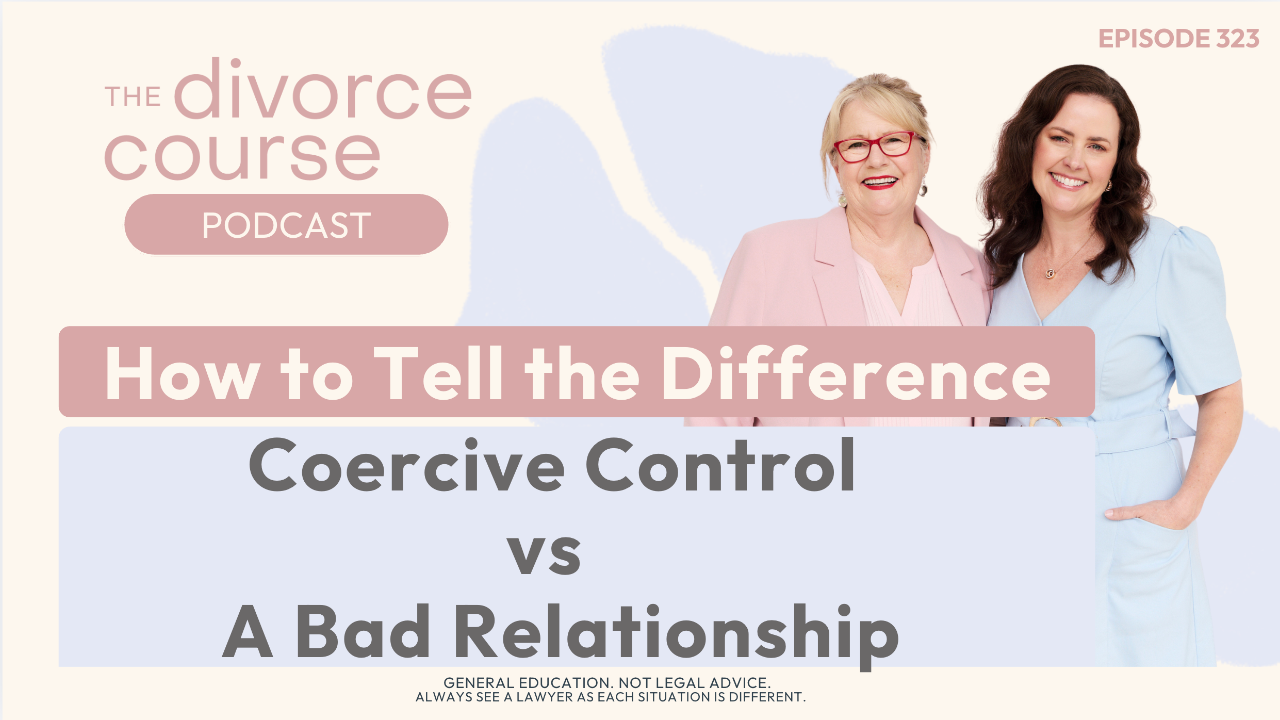
Have you ever lain awake replaying a conversation, asking yourself the same exhausting question: is it me, or are they controlling?
If you have, you are in very good company. When we asked our listeners to send in their questions about coercive control, we were expecting maybe a handful. Instead, we were flooded and underneath almost every single message was the same quiet worry. Is this really coercive control, or am I overreacting? The examples I hear always sound so much worse than what I'm living. Do I even have the right to feel this way?
That one question was so common that Mum and I turned what we thought would be a single episode into a six-part series on The Divorce Course Podcast. And in Part 1, we sit down with clinical psychologist Krasi Kirova to answer the question that came up again and again: is this really coercive control?
This isn't a blog about the extreme, headline-making stories. It's about the quiet, confusing, hard-to-name version – the one where you're walking on eggshells but second-guessing whether you should be. Here's a taste of what Krasi helped us unpack.
Why coercive control doesn't always look like the examples online
One of the reasons coercive control is so hard to name is that it looks different in every single relationship. As Krasi explained to us, it is deeply individualised – almost tailor-made to each person and each household. So when you scan a checklist of "typical" behaviours and none of them quite match your experience, it's easy to walk away thinking, well, it must not be that bad then.
But those checklists tend to feature the most extreme examples. And coercive control exists on a continuum. What it looks like at the quieter end can be a world away from the dramatic examples we see in the media – even though the underlying dynamic, and the harm it causes over time, can be remarkably similar.
Coercive control is a pattern, not a checklist
This was the idea that really shifted things for us. Krasi shared a metaphor we keep coming back to: think of a restaurant. The menu might be completely different from one place to the next, but the function of a restaurant is always the same – you pay, and someone else prepares and serves you food.
Coercive control works in a similar way. The tactics – the "menu" – can vary enormously. But the function stays the same: one person exploiting, dominating and taking advantage of the other. That's why a single incident, viewed on its own, rarely tells the full story. A pattern can only be seen clearly when you step back and look at the whole picture.
The three Ds of coercive control
To make that pattern easier to spot, Krasi describes what she calls the three Ds three elements she says are almost always present:
- Disrespect – the ongoing devaluing of a partner's needs, opinions and self-worth. It's the slow eroding of confidence over time.
- Disempowerment – the wearing away of independence, often by removing choices or limiting access to resources, so that dependence quietly builds.
- Distortion – the reshaping of reality to create confusion, conceal what's happening and lead a person to blame themselves.
The tactics might change from day to day and relationship to relationship. But those three threads, Krasi says, tend to run underneath it all.
When your best qualities get used against you
Here's a part of the conversation that hit home for so many of our listeners. Krasi explained how some of our healthiest qualities can be turned against us in these relationships.
Compromise. Compassion. Agreeableness. Empathy. The willingness to look inward and ask, what could I have done differently? In a healthy relationship, these are the very things that make it work. But in a coercively controlling dynamic, they can be quietly weaponised – used to keep a person giving more and more, questioning themselves, and carrying responsibility that was never theirs to carry.
It's one of the reasons so many people end up feeling like they're the problem. As Krasi put it, these lovely qualities can end up building the cage.
The one question worth understanding: "What is the function?"
Rather than getting stuck on whether a specific behaviour "counts," Krasi kept returning to a more useful lens: what is the function of this behaviour?
A partner who repeatedly delays and deflects. Endless phone calls the moment you step out for lunch with a friend. Anger that only ever appears at home and never in front of the boss. Repeated pressure until you finally give in. On their own, any of these might mean any number of things. But when you widen the lens and look at the pattern, you start to see whether the function is to shape your behaviour, remove your choices and keep you existing in service of someone else.
That reframe – from "is this bad enough?" to "what is this doing?" – is at the heart of the whole episode.
Emotional abuse and coercive control aren't always the same thing
Something else worth knowing: Krasi helped us understand that emotional abuse and coercive control aren't identical. Emotional abuse is always part of coercive control – but you can experience emotional abuse that hasn't tipped over into that full, deliberate campaign of control.
And here's the part we most want people to sit with. Research has repeatedly shown that it's often the emotional harm – not the visible, physical kind – that leaves the deepest, longest-lasting mark. As Krasi noted, many people quietly wish they had a bruise to point to, something visible that would finally be believed. The hardest part of this kind of harm is how invisible it can be, even while it's happening.
If you've been asking "is it me?" you're not alone
If any of this feels uncomfortably familiar, please know two things. You're not overreacting for wanting to understand what you're experiencing. And you are so far from alone this episode exists because of how many people quietly asked the very same question.
There's real hope here, too. When we asked Krasi whether people come out the other side of this into healthy, happy relationships, her answer was an unhesitating yes. It's a process, it's rarely a straight line, and it helps to have a village around you – but people rebuild, reconnect with their children and themselves, and go on to build something genuinely good.
Listen to Part 1 and follow the whole series
This blog only scratches the surface. In Part 1, Krasi works through real questions from real listeners – on anger, financial control, stonewalling, silent treatment, blame-shifting, and whether the main breadwinner can be controlled too. It's the kind of episode people tell us they had to pause and sit with.
And it's just the beginning. Across the six-part series, we're diving into navigating life while you're still in the situation, financial control, protecting your children, healing, and the experiences that often go unheard. You won't want to miss a single one.
Here's how to stay with us:
- Hit subscribe on YouTube, Spotify or Apple so the rest of the series lands in your feed.
- Join our email newsletter at thedivorcecourse.com.au (if it's safe for you to do so) so you never miss an episode – and so you can send us the questions you'd like us to answer. see the link below
Krasi is also taking these conversations further: she's been invited to present on coercive control at the Australian National Psychology Conference, and she'd love to hear what you wish psychologists and therapists understood. There's a way to share your voice – anonymously, and with optional audio – linked in the episode's show notes.
Come and listen. Sometimes just having the words for what you've been living can change everything.
This blog is general education only. It is not legal advice, and it is not a psychological diagnosis of your situation. If anything here lands close to home, please be gentle with yourself and reach out for support.
In Australia, you can call 1800 RESPECT on 1800 737 732 for confidential family and domestic violence support, or Lifeline on 13 11 14 if you're feeling distressed. If you're ever in immediate danger, call 000 (or your local emergency number).
Come along to our next free webinar
Stay connected with news and updates!
Join our mailing list to receive the latest news and updates from our team.
Don't worry, your information will not be shared.
We hate SPAM. We will never sell your information, for any reason.