
What Happens to the Family Home When You Separate?
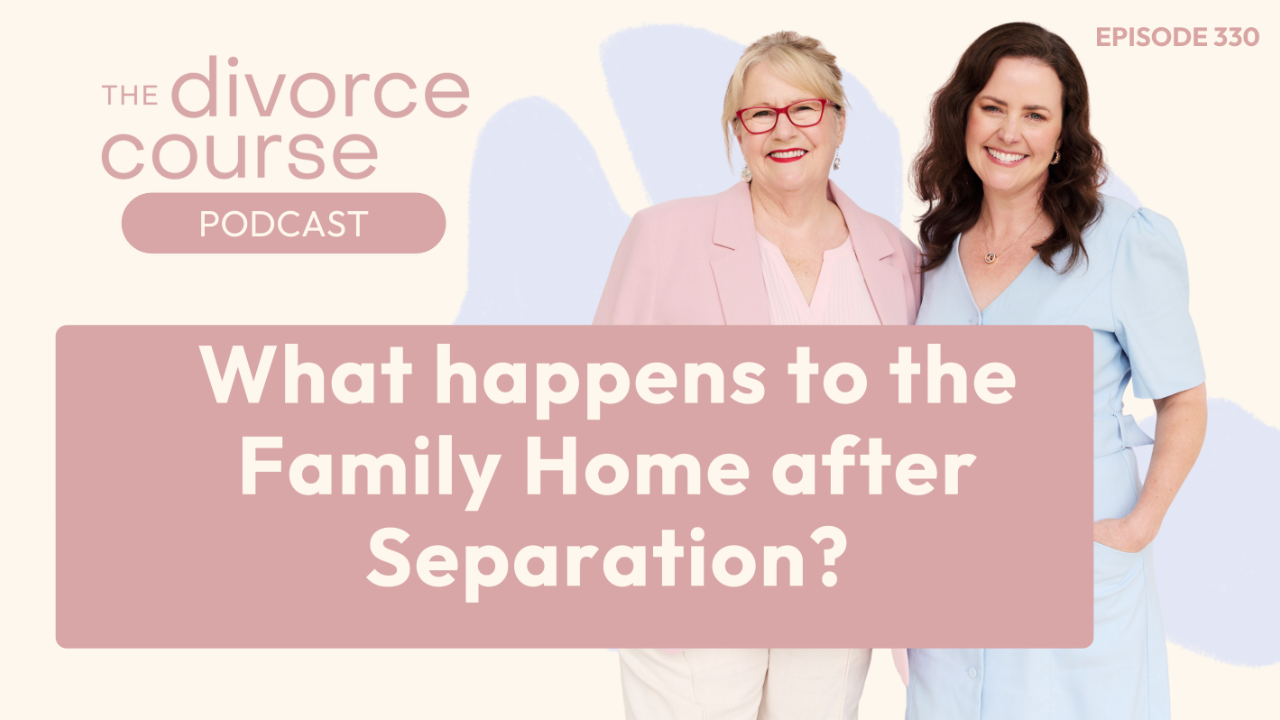
What Happens to the House When You Separate?
A plain English look at the family home, the mortgage, and the questions people ask us most.
If you have just separated, there is a fair chance the house is the thing keeping you awake at 2am. Do you keep it? Do you sell it? Does someone have to leave? And what happens to the mortgage when it has both of your names on it?
In this episode, Mum and I talk through how the family home is treated. Mum is an Accredited Family Law Specialist with more than 35 years of experience, and this is the territory she has spent her career in.
Please read this first. Everything below is general education only. It is not legal advice, and it is not a recommendation about what you should do. Every separation is different, and the right approach depends entirely on your own circumstances, your state, and your family. Nothing here replaces advice from a lawyer who knows your situation.
This article also mentions financial abuse. If you are in danger, call 000. For confidential support, 1800 RESPECT is available 24/7 on 1800 737 732.
There is no special rule book for the family home
The first thing that surprises people is that the house is not treated as a separate, sacred category. It sits in the property pool alongside the superannuation, the cars, the savings and the debts.
It is called the family home, but there is no rule anywhere saying a particular person keeps it.
The Family Law Act does contain one provision specific to this. Section 79(5), and section 90SM for de facto couples, allows a court to consider a person's desire to house the children. How much weight that carries in any given case is something only a lawyer looking at your circumstances could tell you.
What the house is worth is not what it sells for
When people say the house is worth a million dollars, they usually mean market value. In a property settlement the figure that tends to matter is net equity, which is the value less the mortgage.
A house worth $1 million with an $800,000 mortgage has $200,000 of equity in it. Split evenly, that is $100,000 each from the house rather than $500,000.
Mum says this single misunderstanding causes more disappointment than almost anything else in her practice.
Does someone have to move out?
Not necessarily. Plenty of people are separated and still living under one roof, often because nobody can afford to move. Where that becomes unworkable, the courts do have a process, called a sole occupancy application, where a judge decides who stays.
There is also a myth worth naming. You will see content, usually American, claiming that if you move out you lose your claim to the house. Mum's position is that this is not how Australian family law works. Entitlements are worked out on contributions and future needs rather than on who was sleeping where.
If you are weighing up leaving, that is a conversation to have with your own lawyer, because the practical consequences vary a lot depending on your situation.
The mortgage in the in-between period
This is the question that generates the most fear, because the bank does not care that you have separated.
What Mum sees is that courts are generally unsympathetic towards someone who dramatically changes the financial arrangements the day after separation. If one person was the earner and one was raising the children, that was a decision the two of you made together, and it does not evaporate overnight.
Where the person with the capacity to pay stops paying, there are avenues. One that comes up is spousal maintenance, where a court order can direct that an amount be paid to you. Whether that fits your situation is a legal question, not one this article can answer.
Banks are also worth knowing about here. Most of the major lenders have hardship provisions, and many have specific family violence policies. Very few people know to ask.
On financial abuse. Section 4AB of the Family Law Act defines family violence and expressly includes economic abuse. Deliberately cutting off money to force an outcome is something the Act recognises. If that is what you are experiencing, please speak to someone about it.
Do you have to sell?
Selling is not automatic. Mum's experience is that where one person can afford to buy the other out, courts will often prefer that to a sale.
Broadly, there are three directions this goes. One person keeps it. It gets sold. Or it is held jointly for a period, which is less common, because a court's task is to end the financial relationship between two people rather than extend it.
Often the decision makes itself, because one of you can service a mortgage and one of you cannot. Where people cannot agree, the path usually runs through mediation, and where that does not resolve it, to court. Mum's observation is that a judge will commonly order a sale and allow both parties to bid at auction, which is worth knowing before anyone digs in for a fight.
If one of you is keeping it
This part has an order of operations, and Mum is emphatic that getting it wrong is expensive.
The transfer of a property between separating couples is normally done pursuant to an order, whether that is consent orders or a court order. Section 90 of the Family Law Act deals with the stamp duty treatment of transfers made under an order. The sequencing here genuinely matters, and it is one of the clearest examples of something to get advice on before you act rather than after.
From there it is a refinance. The new loan pays out the old mortgage and pays the other person their share. Mum notes that conveyancers often handle the transfer itself more cheaply than family lawyers do, though whether that suits your matter is a question for your own lawyer.
On the buyout figure. People often expect it to be half the equity in the house. In practice it tends to be calculated across the whole pool. If the net pool is $1 million and a 50/50 split is agreed, each side is looking at $500,000. If the house, the car and the super put one person's side of the ledger at $700,000, the gap is $200,000.
On affordability. One thing Mum sees go wrong is people negotiating hard to keep a house, signing orders, and only then discovering what they can borrow. Understanding your own borrowing position early is something a mortgage broker can help with.
On what happens if a refinance falls through. Consent orders commonly include a fallback provision covering that possibility. What that provision says, and what timeframe it uses, is something drafted for the specific circumstances.
Children and the house
Because of section 79(5), a parent's desire to keep a roof over the children's heads is something a court can take into account. Mum's experience is that there is usually some range in what a person might expect, and that this can be a factor within it.
It is a factor. It is not a guarantee, and it does not mean anyone automatically keeps a house.
Where families are in an area they could not afford to buy into now, with children settled in local schools, Mum has seen orders that give one parent occupancy for a defined period with the sale terms agreed in advance. Whether something like that is available to you depends on the whole picture.
If you are both selling
Selling a house is stressful with someone you love. With someone you can barely speak to, it is a different sport.
Agents. A common approach is a panel, where one person nominates a few and the other chooses from that list. Where agreement is impossible, courts can become involved in the appointment.
Where the proceeds sit. Where a split is still being negotiated, funds are often held in a trust account until it is resolved. How that is set up is something lawyers deal with as a matter of course.
Sabotage. Rejecting every reasonable offer is a well-worn tactic, and Mum says people genuinely do end up in court over it. Where a house sells for less than it should have, arguments about adjusting percentages can follow, though it is rarely a dollar-for-dollar recovery.
Divorce sales. Experienced buyers look for signs that a sale is driven by a separation, because it signals motivation. Mum has seen a matter where the parties' falling price expectations were disclosed, and buyers simply waited for the bottom number.
When someone refuses to sign
You have a contract, a buyer is ready, and your ex will not sign the transfer.
Section 106A of the Family Law Act deals with this situation, allowing a court to authorise a registrar to sign in place of a party. Mum has seen matters resolved this way where one person did nothing at all.
It is not a quick fix. There are procedural requirements, including expectations around attempting mediation, and it carries real cost. This is squarely a get-a-lawyer situation.
The four personality types
High conflict. The house stops being an asset and becomes the battleground. Mum's approach is to look for ways to lower the temperature and give the other person some sense of control in the process.
Avoidant. They do not fight. They simply do nothing, and two years disappear.
Manipulative. Delay tactics, shifting conditions, and last-minute problems.
Amicable. The risk here is the handshake agreement that unravels six months later when someone gets different advice.
Each of these calls for a different strategy, and that strategy is something to work out with someone who knows your matter.
A home is just a house
I asked Mum what she would embroider on a cushion for anyone going through this, and that was her answer.
I will be honest, selling mine was painful. I thought it was our forever home. But the house is bricks. Home is where your people are, and you take that with you.
You can do this.
Listen to the full episode on The Divorce Course Podcast, on Apple Podcasts, Spotify and YouTube. We also cover the rapid fire questions, buying a new house before settlement, and preparing a house for sale when you can barely speak to each other.
Related episodes: What Happens With the Mortgage · Inheritances and Property Settlement · I Really Want to Keep the House · Selling the House
Support: 1800 RESPECT 1800 737 732 · Lifeline 13 11 14 · Police 000
This article is general education only. It is not legal advice and should not be relied on as a substitute for advice from a qualified family lawyer who understands your circumstances. Legislation, procedure and practice change over time and vary between states. Nothing in this article creates a lawyer and client relationship.
All our best, Laura & Lyn Your Guides By Your Side Co-Hosts of THE DIVORCE COURSE PODCAST
Come along to our next free webinar
Stay connected with news and updates!
Join our mailing list to receive the latest news and updates from our team.
Don't worry, your information will not be shared.
We hate SPAM. We will never sell your information, for any reason.